
In brief
U.S. stock markets experienced dramatic fluctuations amid ongoing tariff escalations from President Trump, fueling investor concern over economic stability and potential global impact.
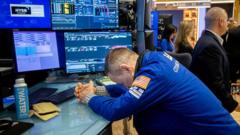
U.S. stock markets are navigating turbulent waters as President Trump’s aggressive tariff policies send shockwaves through financial markets. The S&P 500, which aggregates performance from 500 leading U.S. companies, managed to halt further losses on Monday, closing with a slight decrease of approximately 0.2%. This reprieve came after a rollercoaster day of trading that witnessed notable ups and downs reminiscent of the volatility experienced during the early stages of the Covid-19 pandemic.Despite this moment of pause, tension continues to escalate as President Trump doubles down on his tariff threats, explicitly targeting China while also opening a channel for potential trade discussions with Japan and other nations. In a statement reflecting mixed messages, Trump indicated that while some tariffs may be made permanent, others could be contested through negotiations. More than 50 nations have reportedly sought dialogue with the White House regarding trade relations.Just days following Trump’s new tariff announcements, stock markets in both the U.S. and U.K. faced stark declines—prompting some of the steepest one-day downturns since early 2020, coinciding with the outbreak of the pandemic. As the S&P 500 loses over 10% of its value within a short three-day period, concerns about a downturn comparable to the 2008 financial crisis are growing. Industry experts are voicing frustrations, with Mike Mussio of FBB Capital calling the current policy strategy an "unforced error."Significantly, the ongoing tensions have led to retaliatory measures from China, with critics warning that failure to reach an agreement could lead to dire economic consequences globally. Trump’s additional threats of a 50% tariff on Chinese imports further intensify worries about a potential trade war, aiming to push tariffs on Chinese goods to a staggering 104%.Financial analysts highlight that investor anxiety stems from fears over corporate profits and a slowdown in economic growth. Early trading saw the S&P 500 dip dangerously close to bear market territory—down over 20% from its peak in February—before a sudden recovery spurred by rumors of potential tariff pauses sent stocks surging. Howard Silverblatt from S&P Dow Jones indicated that volatility of this magnitude is rare, emphasizing that uncertainty is driving market behavior.While the Dow Jones Industrial Average ultimately closed down 0.9%, the Nasdaq remained relatively flat. In Europe, markets mirrored U.S. fluctuations, with significant declines reported across leading indices, prompting distress in commodities such as oil and copper, and shaping market sentiments surrounding gold as a "safe" investment.As global leaders contemplate negotiations with the U.S. administration, the persistent anxiety of investors signals a critical juncture ahead in trade relations—a potential tipping point for the future trajectory of the world economy.
