
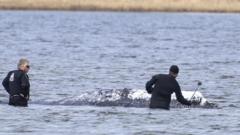
In a dramatic turn of events that has gripped both Danish and German media, a humpback whale named Timmy (and locally dubbed Hope) was hauled from the sands onto the island of Anholt by a massive industrial winch, after a series of failed rescue attempts left the big marine mammal to die in the Baltic Sea.
The incident began in March, when the whale, roughly 12‑15 m in length, became stranded in the shallow waters off the German island of Poel. German environmental workers initially freed the animal by digging a channel, but a later attempt, employing inflatable cushions to pull the whale at the surface and dragging it up the coast on a floating platform, was unsuccessful and the horse remained washed ashore.
German authorities, recognizing the whale’s severe condition and the damage to its skin from salt‑poor waters, authorised a last‑ditch private mission to pull Timmy back into the North Sea. The barge, which had taken the animal away from Germany, eventually released it about 70 km from Denmark’s northern tip. It was this release that set the stage for an unexpected international rescue effort.
In early May, the carcass was discovered on a popular beach on Anholt. Danish environmental officials, warning that gas‑buildup inside the decomposing body could cause an explosive hazard, authorised an industrial winch to tow the whale slowly back to shore. Morten Abildstrøm, a government official on the island, told the daily newspaper Jyllands‑Posten that veterinarians and researchers would investigate the whale after it is cut into manageable sections. The pieces will be transported elsewhere for disposal, preventing a potential “whale‑explosion” similar to those reported when large carcasses have been left unremoved.
The autopsy, planned for Thursday, will seek to establish the cause of death, whether the whale suffered from disease, trauma or the harsh conditions of the Baltic Sea. The outcome could offer new insights into the challenges of marine mammal rescue operations and the long‑term health of stranded individuals.
While the incident underscores the difficulties of saving large whales in hostile environments, it has left Anholt residents bemused and intrigued. The island’s small community, accustomed to the quiet ebb of traffic and the sea, now finds itself unexpectedly linked to a dramatic national saga.
Telegraph images captured the slow tug‑down in a series of Time‑Lapse footage, confirming that the big creature, moment by moment, sank further onto the beach—confirming the urgency to conduct the scientific examination. Every moment from the moment of arrival to the planed post‑mortem will be closely monitored, ensuring that if a solution lies beyond the body itself, the Bangor presence of caution and disaster prevention will surely be apparent.}``````
The incident began in March, when the whale, roughly 12‑15 m in length, became stranded in the shallow waters off the German island of Poel. German environmental workers initially freed the animal by digging a channel, but a later attempt, employing inflatable cushions to pull the whale at the surface and dragging it up the coast on a floating platform, was unsuccessful and the horse remained washed ashore.
German authorities, recognizing the whale’s severe condition and the damage to its skin from salt‑poor waters, authorised a last‑ditch private mission to pull Timmy back into the North Sea. The barge, which had taken the animal away from Germany, eventually released it about 70 km from Denmark’s northern tip. It was this release that set the stage for an unexpected international rescue effort.
In early May, the carcass was discovered on a popular beach on Anholt. Danish environmental officials, warning that gas‑buildup inside the decomposing body could cause an explosive hazard, authorised an industrial winch to tow the whale slowly back to shore. Morten Abildstrøm, a government official on the island, told the daily newspaper Jyllands‑Posten that veterinarians and researchers would investigate the whale after it is cut into manageable sections. The pieces will be transported elsewhere for disposal, preventing a potential “whale‑explosion” similar to those reported when large carcasses have been left unremoved.
The autopsy, planned for Thursday, will seek to establish the cause of death, whether the whale suffered from disease, trauma or the harsh conditions of the Baltic Sea. The outcome could offer new insights into the challenges of marine mammal rescue operations and the long‑term health of stranded individuals.
While the incident underscores the difficulties of saving large whales in hostile environments, it has left Anholt residents bemused and intrigued. The island’s small community, accustomed to the quiet ebb of traffic and the sea, now finds itself unexpectedly linked to a dramatic national saga.
Telegraph images captured the slow tug‑down in a series of Time‑Lapse footage, confirming that the big creature, moment by moment, sank further onto the beach—confirming the urgency to conduct the scientific examination. Every moment from the moment of arrival to the planed post‑mortem will be closely monitored, ensuring that if a solution lies beyond the body itself, the Bangor presence of caution and disaster prevention will surely be apparent.}``````

