In brief
In a landmark July 31 rescue, Australian Skytraders piloted an Airbus A319 into McMurdo Station under total darkness and dangerously low temperatures. The crew, led by Captain Louise Robertson and her husband Rod, faced a four‑hour runway grooming and a 12‑hour weather‑delay, yet successfully extracted a patient on a stretcher and flew him to Christchurch for treatment. This unprecedented operation highlights the precision and partnership essential for winter Antarctic missions and reinforces the capability of Australian aviation specialists.
An Australian aviation crew has carried out a daring midwinter mission to rescue a U.S. expedition member from McMurdo Station in Antarctica in freezing temperatures and total darkness.
Skytraders said the "extraordinary" operation took place last Friday after a request for urgent medical evacuation from the U.S. Antarctic Program. After an initial delay due to the weather, the airline was able to land its Airbus A319 in extremely challenging conditions, including temperatures of –43 °C (‑45.4 °F).
The patient was then safely transferred onto the plane, known as Snowbird 1, which carried him to Christchurch in New Zealand for treatment. He is now recovering well.
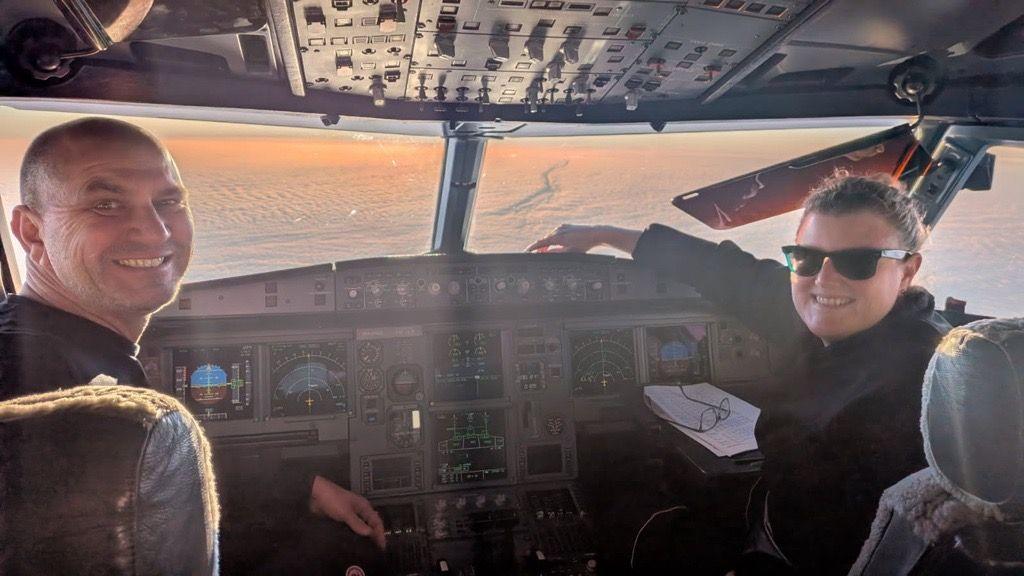
Captain Louise Robertson, one of four pilots on the flight from Hobart, said it was the first operation in July and the first to be completed in total darkness. "We completed it on 31 July, and the first day of any sort of sunlight – which was very minimal – would be 1 August," she told the BBC.
Her husband of 18 years, Rod Robertson, was the pilot who landed the plane at the U.S. research station on Ross Island. "He was in the left seat and I was in the right seat," she added, describing it as the most complex operation in her seven‑year career at Skytraders and 25 years as a pilot.
Skytraders had received the evacuation request via the Australian Antarctic Division on Wednesday afternoon. The flight crew performed a major operation, with engineers fitting a stretcher into the back of the aircraft. The configuration took 24 hours, and take‑off was delayed another 12 hours while the crew awaited a suitable weather window.
“We had a narrow time frame that we could actually fly down to Antarctica because a snowstorm on the first day stopped the operation,” Robertson said. The storm prevented station crews from reaching the runway—a compacted‑snow strip that required six hours of grading and grooming to make it smooth.
The plane eventually took off from Hobart early Thursday morning. The ground crew “did a phenomenal job making a 3‑km‑long runway available for us given the conditions –50 °C and strong wind.”
The flight crew spent exactly one hour on the ground at Phoenix Airfield before a second take‑off to Christchurch. Captain Al Wallach said the success reflected the expertise of the team, which included flight crews, meteorologists, operational planners, runway teams and medical personnel.
“Every Antarctic mission demands absolute precision, but winter operations raise the complexity significantly,” he said. “The conditions we encountered were right on the edge of even the most specialised aircraft capability.”
Emma Campbell, head of the Australian Antarctic Division, said the operation "highlights both the capability of our people and the strong partnerships that underpin Antarctic programmes around the world".
Skytraders carried out a similar mission in March 2020 when the U.S. requested help evacuating a member of the U.S. Antarctic Program, though temperatures were slightly warmer at –30 °C.
Image credited to Skytraders.