In brief
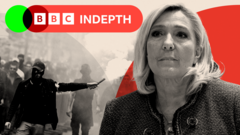
Following the court's decision to bar Marine Le Pen from running for office, France's National Rally faces turmoil as political factions navigate their next moves.
This week, a court ruling to exclude Marine Le Pen from the 2027 presidential race has provoked outrage among France's far right, who view it as a political injustice. This reaction has sparked intense debate on the future of Le Pen and her party, the National Rally (RN). As the airwaves buzzed with indignation, her deputy openly urged supporters to express their anger on French television.Yet, while the ruling has intensified political fervor, it remains uncertain whether it will galvanize support for Le Pen or further splinter the far right. Le Pen and her supporters have declared the nation's democratic frameworks as compromised, likening her treatment to that of imprisoned Russian opposition leader Alexei Navalny. Le Pen proclaimed, "The system has released a nuclear bomb," implying that the judicial actions are a desperate response to her growing popularity as a presidential contender.Prime Minister François Bayrou has voiced concerns about the impact of Le Pen's disqualification on public sentiment. In contrast, some centrist politicians argue for a dichotomy between the judicial and political spheres, reinforcing the need for accountability. Initial polling after the court's decision suggests that only 31% of the populace view the ruling as unjust, a figure notably lower than the 37% expressing interest in voting for Le Pen in the upcoming election. This indicates that while there is significant support for Le Pen, the public also recognizes the legitimacy of the legal rulings against her.On March 31, the court imposed a five-year ban on Le Pen, stemming from evidence of a large-scale fraudulent scheme aimed at defrauding the European Parliament. This decision, criticized as overly harsh by her camp, reflects the judiciary's intolerance towards political corruption, something that Le Pen herself has previously campaigned against.Despite the palpable tension in French political circles, the future of Le Pen and the RN remains unclear. With a range of variables—including the pace of her appeal, potential successors, and the state of France's politics—each presents its own uncertainty. Among those in the wings are Jordan Bardella, Le Pen's potential successor who resonates well with youth, and Interior Minister Bruno Retailleau, both of whom may capitalize on the party's current predicament.As political intrigue deepens, the RN faces the risk of becoming polarized between its core supporters and mainstream voters who still value democratic institutions. As such, future elections in France could bring pivotal shifts that solidify or dismantle the party's influence, depending on whether a broader segment of the electorate ties their support to Le Pen's perceived victimization or the rule of law.In the wake of this historic court ruling, the French political landscape prepares for potential upheaval while considering whether the RN can adeptly navigate these challenges or succumb to internal and external pressures. Marine Le Pen now must strategize carefully to maintain her political relevance in an uncertain future, where the road to power might hinge on public sentiment and party dynamics in forthcoming months.